What is Breast Reduction?
Breast reduction surgery, also known as reduction mammaplasty, involves removal of excess breast skin, fat and gland to improve the appearance of the breast and to help alleviate the symptoms associated with large breasts.
Reduction Mammaplasty Candidates
Individuals with large breasts that are experiencing the following symptoms would be the ideal candidate for a breast reduction:
- Back pain

- Shoulder pain
- Shoulder grooves from the bra strap
- Rashes beneath the breast
- Difficulty exercising
- Difficulty finding bras that fit
- Trouble maintaining good posture

Types Of Breast Reduction Incisions
One of the following incisions is often used:
- Two rings – one larger than the other, around the areola
- A keyhole shape – around the areola and down to the breast crease
- An anchor shape – beginning in the breast crease and extending up to and around the areola
Breast Reduction Procedure
Breast reduction surgery is performed under general anesthesia. Depending on the technique used and the individual case, it can take 2 to 5 hours to perform. During the procedure, one of our doctors will remove the fat, skin, and excess glandular tissue. After the nipple is moved to its new position, the new contour of the breast will be shaped by bringing the remaining skin down and around the areola. Liposuction may also be used to remove any excess fat that remains under the armpit area or as an alternative.
Breast Reduction Before And After Photos
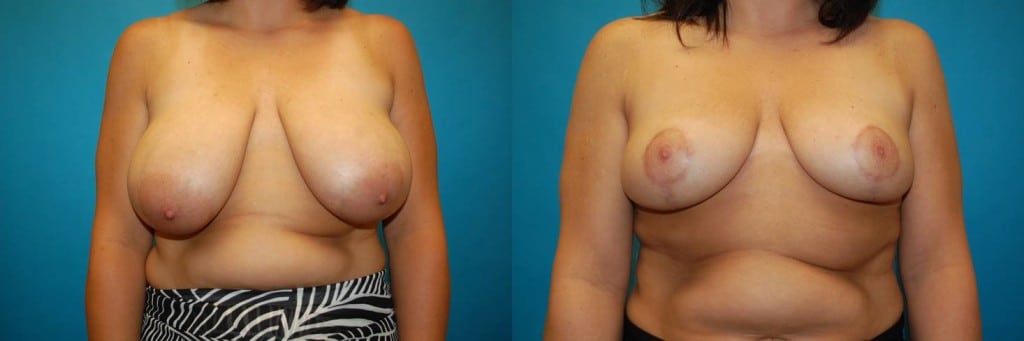
*Individual results may vary
View More Before & After Photos»
See What Our Patients Are Saying!
“Elite has amazing surgeons and staff. The are very involved and care about your well being and do everything to ensure you are comfortable mentally and physically. Choosing Elite was the best decision ever!” – Lisa E.
“I found both the Physicians and staff to be caring & professional throughout my entire experience! It was a very positive procedure experience which never left me with concern or doubt! Thank you Dr. Miller & great staff!” – Lana M.
To read more patient testimonials, click here!
Recovery From Breast Reduction Surgery
Breast reduction surgery is performed on an outpatient basis. After surgery, you will be placed into a surgical bra. The surgical bra is worn most of the time until your follow-up visit. At that time you may go into a softer bra. Most patients take 2 weeks off of work. You may be able to return to work sooner depending on the type of job. Strenuous jobs may require longer time off of work. One of our board-certified plastic surgeons will help you determine the time off of work at the time of your consultation.
Can I Breastfeed After My Breast Reduction?
Breast reduction surgery removes portions of the milk-producing parts of the breast. Because of this, some people will have difficulty with breastfeeding after surgery as milk production might not be sufficient.
Alternatives To Breast Reduction Surgery
Liposuction alone can sometimes be used to reduce breast size. One advantage of liposuction is that it leaves little-to-no scarring. However, because liposuction removes only fatty tissue, patients must have more fatty tissue than glandular tissue in their breasts. Liposuction is often used on men whose breasts are enlarged.
When Can I Drive Again After My Breast Reduction?
Your first milestone to reach before you can drive is that you’re no longer taking prescription pain medication to manage comfort. You might switch to over-the-counter medication within a week or two after your breast lift. Transitioning to over-the-counter pain relievers also indicates that you’ve reached your second milestone, comfort! As long as you can wear your seatbelt properly and comfortably and drive with your hands properly placed on the steering wheel, you should be safe to drive. We recommend sitting in the car for a few minutes and running through your normal range of motion before hitting the road.
What Plastic Surgery Procedures Can Be Combined With a Breast Reduction?
Combining plastic surgery procedures can be advantageous on multiple levels. Not only can you achieve enhanced results, but you can do so without extended downtime. One surgery, one recovery period, impressive results! It is likely that your breast reduction procedure will involve a breast lift. Beyond that, you can consider options like liposuction, abdominoplasty, or other techniques that will enable you to feel like your best self. When you consult with one of our experienced surgeons, discuss all of your aesthetic concerns. We’re here to help you address them with as much creativity and efficiency as is needed.
Does a Breast Reduction Leave Scarring?
Scarring is an inescapable aspect of surgery. You can better understand what to expect in terms of post-operative scars when you consult with your surgeon. At this visit, your doctor will determine the best incision pattern for your shape and desired outcome. Sometimes scars are localized around the areolas. For more substantial breast lifts, incisions may also run vertically from the areolas to the breast crease, as well as horizontally across the inframammary fold. Even the most extensive incision, the anchor incision, can achieve remarkable outcomes. With proper care, you can expect your scars to heal very nicely. It just takes some time, so patience is a must.
Are There Procedures to Help the Small Scars Fade Faster?
There are several ways to promote optimal wound healing after surgery. As soon as your incisions have completely closed (confirmed by your doctor), you might begin treating incision scars with a topical solution or silicone sheets. This is often all that is needed to assist the resolution of scarring. While you will always have a line on the skin where your incisions were made, these will fade significantly over time. With advancing technology in the area of laser skin rejuvenation, we may also have an option for a professional scar treatment that would work well for you. Just give us a call to discuss suitable treatments.
Are Breast Reductions Painful?
Your outpatient breast reduction procedure occurs under general anesthesia. This model of deep sedation “shuts off” the transmission of pain signals for the duration of your procedure. The effects of general anesthesia may last for a short time after surgery, so you may not begin to feel discomfort until you’re ready to be released from the surgical center. After breast reduction, the surgical area may feel sore and tender. Your compression garment will help minimize these side effects.
Are the Results of Breast Reduction Surgery Permanent?
We anticipate the results of breast augmentation to endure indefinitely. That said, the breasts are made up primarily of fatty tissue, and fatty tissue can enlarge based on a few distinct factors. Weight is the factor that is discussed most often for breast reduction patients. However, hormones can also contribute to changes in breast tissue after breast reduction surgery. Some women experience hyperplasia, which is the continued growth of breast tissue due to high levels of estrogen. Fortunately, this is an uncommon condition and one that may be managed with appropriate clinical therapy such as hormone optimization. Most commonly, women who seek breast reduction are encouraged to work toward consistent weight management through healthy lifestyle choices.
Keep in mind that, even with proper physical care after breast reduction surgery, your breasts will continue to change to some degree as a normal part of the aging process. If, at some point, you feel unhappy about deflated or saggy breasts, you can visit Elite Plastic Surgery in Grand Rapids for breast augmentation or a breast lift.
What Can I Do to Support Long-Term Breast Reduction Results?
Your way of living impacts your appearance in a variety of ways. As your breast reduction procedure approaches, you can benefit from learning about the various steps you can take to support the best and longest-lasting results. These begin to develop right away after surgery as you help your body recover optimally.
The initial recovery from breast reduction surgery lasts about six weeks in total. However, healing continues on a more subtle level for about 18 months! It’s important that you continue to follow your doctor’s recommendations for the entirety of your recovery process. During the first year and a half after your procedure, you’ll maintain a focus on the following:
- Scar care. It takes a year or longer for scar tissue to flatten and fade. At some point, you can begin using silicone strips or scar creams to support the maturation of this tissue.
- Resuming exercise. Many women express an interest in exercise after breast reduction. Understandably, because overly-large breasts often make exercise uncomfortable! When you begin an exercise program after breast reduction, even after months of healing, it is important to go slow. Avoid activities that place a lot of stress on the chest until you’ve fully recovered, and, even then, take your time easing into the intensity that is right for you. Keep in mind that light exercise and taking your time will yield the best results in the long run.
- Choosing the right bras. Your general recovery period may last six to eight weeks, but that does not mean that your skin and chest area will be ready for you to wear push-ups or underwire bras. If you wear an underwire too soon after breast reduction surgery, you may experience unnecessary irritation.
- Sustaining Support. One of the benefits that many women perceive they’ll gain from breast surgery in general, including breast reduction, breast lift, and breast augmentation, is the ability to go braless. This must be strictly avoided during your recovery period and should be done only occasionally after the breasts and scars have fully healed. A comfortable, supportive bra is your best friend to maintain perkier, shapelier breasts after your breast surgery.
Risks Of Reduction Mammaplasty
In addition to the risks associated with any surgical procedure, risks related to breast reduction, depending on the technique used, include the following:
- Scarring
- Asymmetry
- Excessive firmness
- Loss of sensation
- Inability to breast-feed
- Partial or total loss of areola and nipple
- Loss of skin/tissue where incisions meet
Although reduction mammaplasty provides long-lasting results, breasts are still subject to the effects of aging and gravity.
Schedule A Consultation
Schedule your consultation today to meet with one of our board-certified plastic surgeons to determine if breast reduction is right for you. Call (616) 459-1907 to contact our Grand Rapids office today!